

REDEFINING THE
STANDARD OF CO₂
LASER BLEPHAROPLASTY & PERIOCULAR RESURFACING
Blepharoplasty is among the most performed aesthetic procedures worldwide1. Oculoplastic surgeons and ophthalmologists have the eyelid expertise to meet the demand with training, precision, and clinical experience. Tap into a new revenue stream, diversify treatment options, and lead the field.

AI-generated image for illustrative purposes

CLINICAL OPPORTUNITY
WHY PERIOCULAR MATTERS
The periocular area is one of the most common drivers for patient consultations, driven by both functional and aesthetic concerns. Age-related changes such as excess upper eyelid skin, fine lines, photodamage, and lower eyelid contour irregularities significantly impact facial appearance—and in some cases, visual function. Patients increasingly seek visible improvement with minimal invasiveness and downtime.
BRIDGING THE TREATMENT GAP

Periocular resurfacing (“Mini-Bleph”) bridges the gap between light aesthetic treatments and full surgical blepharoplasty, offering earlier, targeted periocular intervention.
PROJECTED MARKET SIZE
Driven by both functional and aesthetic need, the U.S. eyelid surgery market is projected to reach $3.04 billion by 2030.2
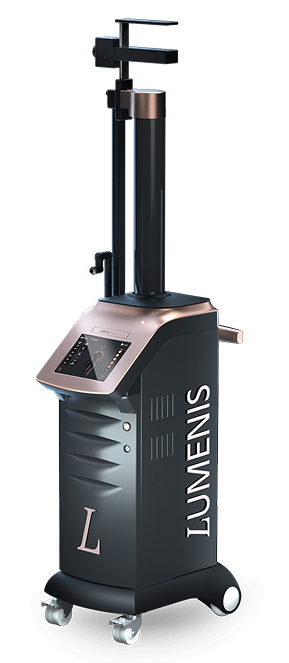
FROM FUNCTIONAL CORRECTION TO MINIMALLY INVASIVE REJUVENATION ON ONE PLATFORM
TARGETED PERIORBITAL RESURFACING
83% OF ADULTS SHOW SIGNS OF PERIOCULAR PHOTOAGING3, FROM FINE LINES TO MILD TO MODERATE WRINKLING.
Targeted CO₂ resurfacing treats skin quality, fine lines, and early signs of periocular aging.
UPPER EYELID CO₂ LASER BLEPHAROPLASTY
DERMATOCHALASIS AFFECTS ~16% OF ADULTS AGED ≥45 YEARS, REFLECTING A COMMON AGE-RELATED EYELID CONDITION4.
Precision incision and excision with controlled coagulation deliver clean, low-bleeding correction of excess upper eyelid skin.
LOWER EYELID BLEPHAROPLASTY
LOWER EYELID AGING COMMONLY SHOWS UP AS PROMINENT WRINKLES, UNDER-EYE BAGS, AND PERIORBITAL SKIN LAXITY.
Targeted contour correction with enhanced visualization addresses lower lid irregularities and fine textural change.


AI-generated image for illustrative purposes
BEFORE & AFTER CO₂ LASER PERIOCULAR PROCEDURES


Upper & Lower Lid Bleph with Periocular CO₂ Resurfacing
Courtesy of Dr. Emilio Justo


Upper & Lower Lid Bleph with Periocular CO₂ Resurfacing
Courtesy of Dr. Emilio Justo


Upper & Lower Lid Bleph
Courtesy of Dr. Emilio Justo


Upper & Lower Lid Bleph with Periocular CO₂ Resurfacing
Courtesy of Dr. Emilio Justo
WHY CO₂
Designed for Periocular Precision. Powered by CO₂.
Clinical & Practice Value
Why CO₂ For The Periocular Area
Why UltraPulse Alpha
BUILT FOR THE EYE
One device | All-around ocular treatment
UltraScan™ CPG for Periocular Resurfacing

Collimated 1.3mm spot diameter. full/fractional superficial periorbital laser resurfacing from a variable distance from the tissue. Treat upper and lower eyelid skin with targeted CO₂ resurfacing designed to improve skin quality and fine lines through collagen remodeling. Clinically supported for safe integration with blepharoplasty5, Mini-Bleph expands the periorbital treatment continuum—addressing patients before surgery while creating an additional cash-based opportunity for the practice.
Read MoreIncisional HP for Upper and Lower Blepharoplasty

0.2mm & 1.0mm spot diameter. Focused beam for incision and excision of tissue. Combine precise incision with immediate coagulation to reduce bleeding and swelling versus a scalpel6 - supporting a more comfortable early recovery period.7
Read MorePRESETS AND AUTOMATIONS TAILORED BY PROFESSIONALS
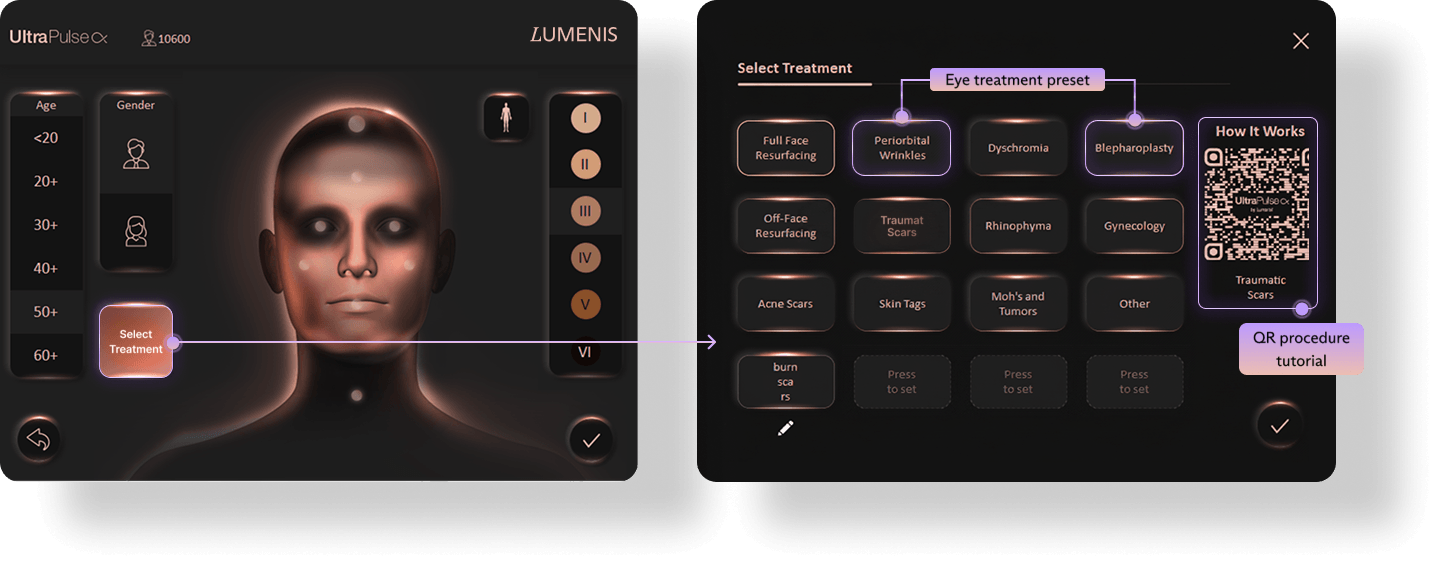
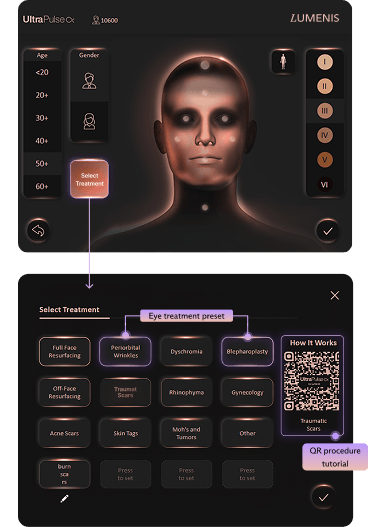
MORE APPLICATORS.
MORE TREATMENT POSSIBILITIES.

“The Eraser” TrueSpot™
Collimated 2mm spot diameter. Multi-pass, quick debulking of tissue. Commonly used in Rhinophyma, skin-tag removal, and more.

DeepFX™ Microscanner
120µm spot diameter. Deep fractional resurfacing up to 4mm in a single pulse for all types of scars, deep or thick lesions.
HIGH POWER VS. LOW POWER
In periocular treatments, power is not about aggressiveness—it’s about control. High peak power delivered in ultra-short pulses enables faster tissue interaction, limiting heat diffusion and supporting safer, more predictable healing.
- Fast, high-peak energy delivery in short pulses
- Reduced heat spread into surrounding tissue
- Faster, more predictable healing
- Controlled, precise response in delicate periocular skin
- Slower energy delivery
- Increased heat spread into surrounding tissue
- Greater risk of prolonged inflammation and recovery
- Less predictable response in delicate periocular skin
FREQUENTLY ASKED QUESTIONS
The CO₂ wavelength (10,600 nm) is highly absorbed by water in the skin, allowing precise and controlled tissue removal. This makes ablative CO₂ technology particularly well suited for delicate periocular procedures, including CO₂ laser blepharoplasty and periocular resurfacing.
Higher peak power delivers the required energy in shorter pulses, reducing the need for repetitive pulses and helping minimize heat diffusion into surrounding tissue. With up to 240 W peak power, UltraPulse α supports precise ablative CO₂ treatments, including periocular resurfacing and CO₂ laser blepharoplasty.
WHAT IS THE DIFFERENCE BETWEEN TRADITIONAL BLEPHAROPLASTY, CO₂ LASER BLEPHAROPLASTY, AND MINI-BLEPH?
Conventional blepharoplasty removes excess eyelid tissue using surgical instruments. CO₂ laser blepharoplasty performs the same surgical procedure using ablative laser energy for incision and tissue removal. Mini-Bleph is a non-surgical treatment that uses ablative CO₂ periocular resurfacing on the upper and lower eyelids to improve wrinkles, skin texture, and overall eyelid appearance. UltraPulse α supports all three treatment approaches on a single platform.
Yes. With UltraPulse α, physicians can perform both CO₂ laser blepharoplasty and ablative CO₂ periocular resurfacing in a single treatment session, addressing both tissue correction and skin rejuvenation with one platform.
Mini-Bleph is designed for patients seeking eyelid rejuvenation without surgery. Using ablative CO₂ periocular resurfacing, it can improve fine lines, wrinkles, skin texture, and mild to moderate skin laxity of the upper and lower eyelids. Laser resurfacing under the eyes may also help address crepey skin and etched lines. Patients with significant excess eyelid tissue may be better suited for conventional or CO₂ laser blepharoplasty.
The difference is pulse duration and the amount of energy delivered with each pulse. Higher-power CO₂ systems can achieve the desired treatment depth with shorter, more powerful pulses, reducing the need for pulse stacking. By reaching clinical endpoints with fewer pulses, less heat accumulates in surrounding tissue, helping minimize residual thermal damage. Lower-power systems may require pulse stacking or longer pulse durations to achieve similar effects, increasing thermal impact on adjacent tissue.
Recovery time depends on the treatment parameters selected, including ablation depth, coverage density, and the number of passes performed. More intensive treatments typically require longer recovery, while lighter treatments may involve shorter downtime. Settings are customized based on each patient’s goals, anatomy, and treatment plan.
Blepharoplasty is among the most performed aesthetic procedures worldwide1, and the eyelid surgery market is projected to reach $3.04B by 20302. By enabling both CO₂ laser blepharoplasty and ablative CO₂ periocular resurfacing on a single platform, UltraPulse α helps practices address growing demand for both surgical and non-surgical eyelid rejuvenation procedures.
CONTACT US
New to Lumenis? Fill in your details and a representative will get in touch with you.
1021059 Rev A
AI-generated image for illustrative purposes

Refer to the User Manual for the complete list of contraindications, warnings, precautions, and risks associated with the product.
- International Society of Aesthetic Plastic Surgery (ISAPS). ISAPS International Survey on Aesthetic/Cosmetic Procedures Performed in 2024. 2025.
- Grand View Research. Eyelid Surgery Market Size, Share & Trends Analysis Report. Grand View Research.
- Green AC, Hughes MCB, McBride P, Fourtanier A. “Factors Associated with Premature Skin Aging (Photoaging) before the Age of 55: A Population-Based Study.” Dermatology. 2011;222(1):74–80.
- You H, Kim G, Lew H. “A Novel Classification of Senile Dermatochalasis: Insights from Clinical and Histological Analysis.” Graefe’s Archive for Clinical and Experimental Ophthalmology. 2024;262:2643–2649. doi:10.1007/s00417-024-06430-z.
- Watson AH, Van Brummen A, Somogyi MB, Homer N, Nakra T. “Potent Periorbital Fractionated CO₂ Laser Resurfacing.” Dermatologic Surgery. 2022;48(10):1089–1091. doi:10.1097/DSS.0000000000003533.
- Morrow DM, Morrow LB. “CO₂ Laser Blepharoplasty: A Comparison with Cold-Steel Surgery.” Journal of Dermatologic Surgery and Oncology. 1992.
- Biesman BS. “Blepharoplasty: Laser or Cold Steel?” Skin Therapy Letter. 2003.